
When a Republic Fights Itself – Part 1
The Domestic Security Crisis America Must Confront

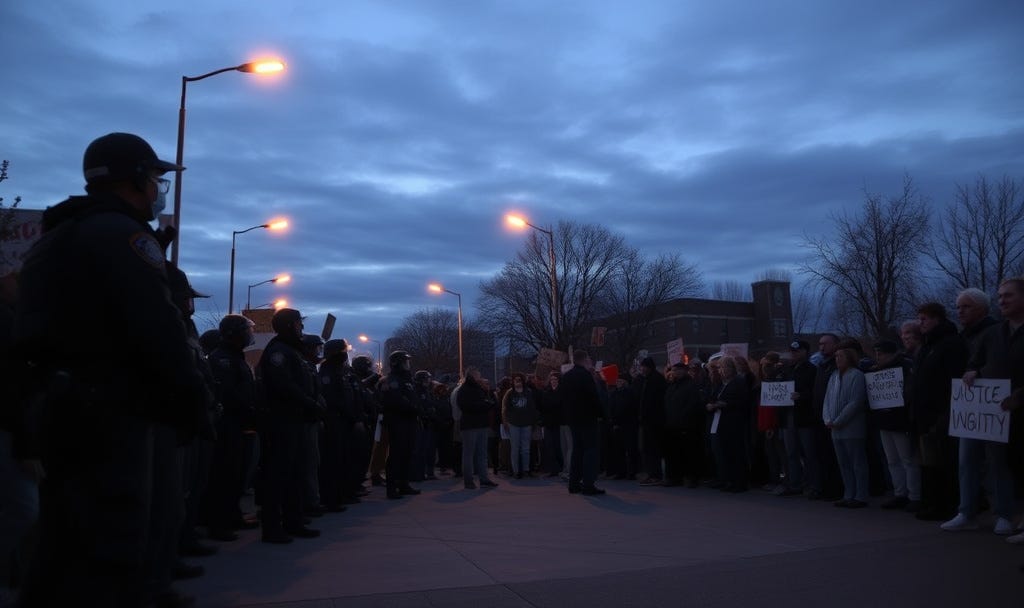
Bearing Witness
February is Black History Month—a time to remember how Americans have wrestled with our republic’s foundational promise and contradictions since its birth. But in 2026, the struggle isn’t a historical artifact to be studied from a safe distance. It’s a live question and challenge for our democracy on the streets of Minneapolis and in cities across the nation.
Governor Tim Walz has openly warned that he fears a “Fort Sumter moment in Minneapolis.” The governor’s warning is an alarming reflection on the urgency of the moment. We all feel his anxiety, whether we want to admit it or not.
Meanwhile, aggressive ICE operations continue in Democrat-governed cities across the country, including Minneapolis, Boston, Chicago, and Denver. Families separated. Children traumatized. Communities are forming “ICE watcher” networks to document federal activity in real time because they no longer trust that accountability will come from within the system.
Struggle in Real Time
I’ve spent several weeks wrestling with the tragedy unfolding in Minneapolis and cities across the nation. I’ve drafted and deleted a dozen reflections, trying to make sense of what my eyes and ears are telling me—trying to come to grips with how it makes me feel. Each time I tried to start with a strategic framework, the words felt like evasion. Each time I started with rage, the words felt like a performance. I could not bring my head and heart into alignment because what we are witnessing is not a policy debate about immigration enforcement—a legitimate and complex issue. I could not come to terms (on any level) with the use of lethal federal force against American citizens under “disputed circumstances,” followed by immediate efforts to justify those actions with demonstrable falsehoods that collapse under scrutiny.
I find myself incredulous—caught between righteous outrage at what is happening and the discipline required to think strategically about what should and can be done about it. Between the moral clarity that says this is wrong and the recognition that outrage alone will not build the coalitions, craft the policies, or secure the remedies required to repair what is breaking.
Some might ask why I’m using my platform, focused on strategic literacy and national security, to address domestic immigration enforcement. My answer is straightforward: legitimacy is a strategic asset. When federal agents, shielded by dubious authorities, kill American citizens and senior officials defend their actions with callous indifference, the United States burns through the very credibility that underpins both domestic governance and our international legitimacy as a democracy. What happens on the streets of Minneapolis doesn’t stay in Minneapolis—allies watch, adversaries watch, and both draw conclusions about America’s reliability and commitment to the principles we claim to champion.
I need to acknowledge my anxiety, disbelief, and fury honestly, because I suspect many of you feel the tension too. What is happening to our country?
Mission [Im]possible…?
I launched Reconnecting the Republic because I believe that strategic literacy—the capacity to understand and engage with one another about how and why choices regarding U.S. national and domestic security, governance, and democracy are made—can help Americans hold leaders accountable and participate meaningfully in self-government.
But right now, I’m struggling with whether the work of “reconnecting” is even possible when so much is actively, recklessly, and willfully—it seems, almost “gleefully”—being broken.
We are not in a period of simple policy adjustment about immigration. We passed that Rubicon.
Now, the world was watching as federal agents killed American citizens who were lawfully engaged in their Constitutional right to protest peacefully. The world is watching now as our government inflicts authoritarian-style violence on Americans – behavior that the United States has justly condemned when other governments have attacked their own citizens.
Senior Administration officials make matters worse by gaslighting the American public and justifying the killings with false narratives that denigrate victims and disrespect American laws and values. Americans are not “stupid people.” We have eyes and ears. We can see clearly the wrongs being done in our name, and we don’t buy the lies being told to us. This tragedy is evident to every American – or, in my opinion, it should be.
The Administration has so far refused to set clear legal boundaries on ICE operations. It has rejected legitimate calls from Congress to implement accountability mechanisms to curb the agency’s abuses of power. It is increasingly difficult for many Americans to distinguish between safety and threat when both wear uniforms.
It’s appalling, heartbreaking, and infuriating!
I’m sure that I’m not the only one who holds his breath, hoping desperately for some kind of deus ex machina-like event to deliver us and serve actual justice. But no, that’s a Hollywood fantasy, and I know it.
No one is coming to save us. We need to save ourselves.
Looking to History for Answers
So, I look to the past for answers. Specifically, I reach for the examples that shaped my understanding of what resistance requires—Dr. King’s strategic patience, the discipline of the Southern Christian Leadership Conference, and my uncle Phillip, who, in his youth, led desegregation sit-ins at Woolworth-style counters in his small Oklahoma town. Their examples burn in my mind like a challenge: they faced armed resistance, legal persecution, and physical violence of a kind I could not imagine until now, with nonviolent persistence. They understood and played the long game with their very lives.
Their courage is inspirational. But I have serious doubts. Will those same strategies work now that the antagonists already have our playbook? When they’ve studied our tactics and built counters into the system itself? When the machinery of resistance has been catalogued, analyzed, and prepared for?
I imagine conversations with those who came before—not as a romantic fever dream but as an honest reckoning. What would they say about this moment? What would my uncle Phillip (z”l) –who risked everything in a small town where everyone knew his name – make of federal agents killing citizens on camera while senior officials immediately spin false narratives to justify it?
I think he’d say: the tools change, but the principles don’t. You bear witness. You organize. You demand accountability. You build coalitions. You play the long game even when every fiber of your being tells you to wait it out…let it pass over you and yours. You’ll be fine. Or, even when your racing heart says run! You plant your feet and fight.
And then I think he’d ask, “So, what are you going to do about it?”
Honestly, I’m still working on that answer. But I know it starts with refusing to look away.
Stand and Fight!
Senator Rev. Raphael Warnock invoked one of the lessons from the civil rights era in a recent interview with Mika Brzezinski and the Reverend Al Sharpton on Morning Joe: after President Lyndon Johnson told Dr. King he lacked the power to push through voting rights legislation, King told his staff, “We’re going to have to go and find the president some power.” Selma was the answer—a campaign of nonviolent agitation that created the political context for the Voting Rights Act.
Senator Warnock, who also serves as pastor of Ebenezer Baptist Church in Atlanta—Dr. Martin Luther King Jr.‘s church—has called ICE abuses nationwide: a “spiritual crisis,” and announced his intent to block funding for ICE, potentially triggering a government shutdown. “When you build a beast,” he said, “it’s gotta eat. And we’re witnessing it eat and consume the bodies of ordinary citizens.”
He’s not wrong. But here’s where I’m struggling again: I don’t know if Americans today are prepared for the kind of long, disciplined, strategic fight the senator’s analogy implies.
Political analyst John Heilemann, who writes about American democracy and political polarization, has observed that the civil rights movement took years, the Vietnam War protests took years, and this fight will likely take years too. And he’s right. We are at the beginning, not the end—in the first quarter with three more to go... The everyday craziness of it all has been too much, and I’m not sure we’ve fully reckoned with what that means.
The Administration’s “One Big Beautiful Bill”—authorized and allocated roughly $74.85 billion to ICE over a four-year period. If the agency spends it evenly, that averages to about $18.7 billion per year, in addition to the base appropriations. That means ICE operating funds rival what the United States Marine Corps spends to modernize, arm, and equip itself to fight U.S. adversaries, and match or exceed the budget of U.S. Special Operations Command—the elite joint command responsible for counterterrorism, hostage rescue, and global special operations.
That’s insane!
Hitting ICE with a gut-punch to its budget, as Senator Warnock proposes, is a sound tactic and a good start, but it will not deliver the knock-out blow that stops the agency from wreaking havoc in American cities. And for the record, I do not agree with calls to abolish ICE. We need border enforcement. We don’t need an out-of-control, poorly trained, mask-wearing private army that tramples on the Constitutional rights of U.S. citizens and those seeking a better life in America to do it.
ICE is only one of many issues Americans must confront. The real challenge is three more years of damage being done right now—to constitutional norms, to trust in institutions, to communities and families, to America’s international standing—that will take even longer to repair.
So, I’m pulled in opposite directions: wanting to offer a strategic way forward and wanting to “throw hands” because what ICE is doing is wrong and it must stop it now. Wanting to believe that reconciliation is possible, while recognizing that reconciliation requires truth, accountability, and repair—none of which are currently on offer.
This is not despair. It’s just honesty about where we are. And honesty is where strategic citizenship begins.
Author’s Note:
This post is my honest attempt to bear witness to what is happening on American streets in early 2026 while maintaining the strategic analysis that Reconnecting the Republic is built to provide. I’m navigating the same tension many of you feel—between moral clarity and strategic patience, between rage and hope.
In Part 2, I’ll examine why this domestic crisis is inseparable from America’s national security posture—how legitimacy at home connects to credibility abroad, and why the erosion of constitutional norms on American streets signals vulnerability that allies and adversaries alike are watching closely.
In Part 3, I’ll propose a path forward that acknowledges both the urgency of this moment and the discipline required for the long fight ahead. Because strategic citizenship is not a solo endeavor. It is the work we do together.
If this resonates—whether you agree with me or hold another point of view—I invite you to join the conversation. You cannot reconnect what you refuse to see clearly.
— Tony Johnson
Reconnecting the Republic
February 2026
Thank you Tony! You offer an informed, eloquent, and expert perspective that reflects many conversations I've been having within my congregations, community, and among clergy colleagues. Stay the course! We need you.
Thank you for writing and sharing!