
What Passover Requires of Us Now
A Pesach Epistle — and Questions for Your Seder Table

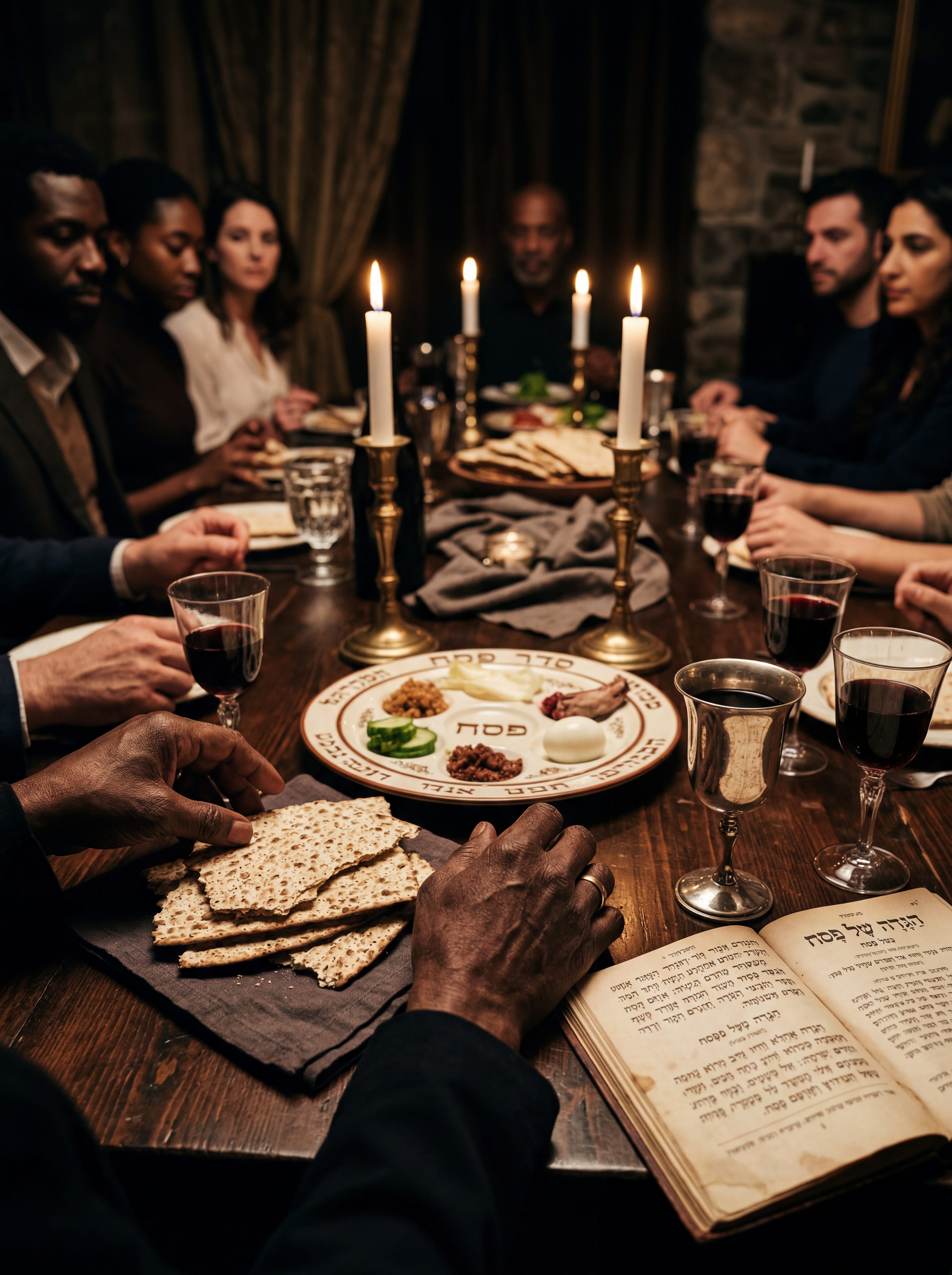
I wrote this letter of reflection to my fellow synagogue congregants in Washington this week. I’m sharing it here because the questions it raises belong to all of us. The story of liberation was never meant to be comfortable. It was meant to be thorough — like the search for chametz, leaving no corner unexamined.
I’m Black and Jewish. This year, my husband and I are hosting the Passover Seder.
Around our table will be many loved ones — Jews and non-Jews — including members of a Jewish family who have warmly adopted me as one of their own. They’re American-born. But one of them — a son, a brother — has lived in Jerusalem for years. His children are Israeli. And one of them is serving in the Israel Defense Forces.
I spoke with him this week. He called from Jerusalem, where Passover preparations were already underway — the cleaning, the cooking, the particular texture of a holiday that arrives the same way every year, regardless of what the world has done in the intervening twelve months. This year, the world has done quite a lot.
I’ve spent years inside the Pentagon and the State Department — at the elbow of senior officials, advising on decisions most Americans never see made, and working to ensure those decisions serve the country, not just the institutions or the officials appointed to lead them. I write about the mandates, roles, and missions of those institutions — how they work, when they hold, when they don’t — on Reconnecting the Republic, built on the belief that citizens deserve to understand the foreign policy and national security decisions made in their name.
That background shapes how I listened to my brother in Jerusalem. And what I heard was more than what the headlines have been offering Americans in the United States.
Jerusalem, This Week
My brother described the cohesion specific to Israeli Jews — held together not by confidence in their government but by the quiet solidarity of people who share a fate — the sense that, whatever Prime Minister Netanyahu is or isn’t doing, the people around you are still your people. Fear, resolve, numbness, and deep cynicism about the political class coexist somehow with the ordinary functions of daily life. Underneath that cohesion, an older fracture persists — between Israelis who bear the cost of the country’s security and those who, by political arrangement, do not. And, at the heart of it all, children who have grown up through COVID and two years of war treat the whole arrangement as routine as the weather.
He described something else, too — a moral dislocation he carries quietly, because it isn’t welcome at most tables. My brother sees the suffering of civilians in Gaza and Lebanon in ways that his community, by the logic of sustained threat, has largely stopped seeing. He isn’t outside his community — his family has deep military roots; his children serve — but he carries a moral minority view he’s learned to hold carefully, in private.
My brother described to me how he expects to experience Passover this year: “Tony, I’ll sit at a table where the ancient questions are asked. But the questions I most want to ask won’t make it into the room.”
But I listened to him. And what I heard in his story made me more mindful of ours.
The Enduring Wisdom of the Seder
The Haggadah isn’t a triumphalist document. It’s the vehicle we use to tell our liberation story — but we also dip our fingers in wine and name the plagues. Ten times. Not as an afterthought. As an obligation. Our tradition insists: you may not celebrate your freedom without acknowledging the cost borne by those who were not liberated alongside you.
This isn’t political commentary. It is liturgy. It has been for more than two thousand years. The story of liberation was never meant to be comfortable. It was meant to be thorough – like the search for chametz, leaving no corner unexamined.
This Passover, American and Israeli Jews sit with a version of that same accounting. The war that the United States and Israel are waging against Iran and its terror network has produced real strategic results.
The adversaries of the United States and Israel — Iran, Hezbollah, Hamas — are more weakened than at any point in a generation: their “axis of resistance” shattered and their proxy network degraded under years of sustained pressure — hobbled, though not finished. My brother said this plainly, unsentimentally, and without boasting: “For all the darkness of the past two years, the enemies Israel truly dreaded are indisputably weakened. That’s a strategic fact.”
It’s also true that the methods used to achieve this strategic outcome have troubled many of us, both Americans and Israelis. Not as a political position or a pragmatic security judgment. As a moral one.
The Haggadah asks us to hold both. The seder table is where we practice doing exactly that.
The Questions We Owe Ourselves
Is there a pragmatist’s case for what comes next — a potential shift in American and Israeli leadership toward someone who thinks in terms of durable outcomes rather than permanent advantage, a regional architecture that could actually marginalize the extremist networks that have fed on decades of instability, Iranian and Palestinian political figures capable of meeting pragmatism with pragmatism, if ever given the chance?
The pragmatist case is real. So is its fragility. The political forces capable of foreclosing it before it ever becomes available are organized, patient, and currently ascendant.
What American Jews can do — what citizens of our republic can do — is refuse the binary. The choice isn’t between celebrating a strategic outcome and condemning the way it was achieved. Those are not the only options available to us. The harder and more honest option is what the seder has been reckoning with for millennia:
Tell the whole story. Name what has been gained. Name what it costs. Ask what we owe, going forward, to the work of building the regional political conditions this war has not yet created — and that no military campaign, however successful, can create on its own..
When I asked my brother in Jerusalem what he hoped to tell his kids in twenty years about this period, he paused for a long time.
Then he said, with characteristic frankness, “I have no f-ing idea, Tony.”
That honesty felt to me like the beginning of something real.
After all, what will I, as an American Jew, say to my nephews, nieces, and two godsons about this period? I, too, have no idea.
But I do have questions for the here and now.
Questions for the Pesach Seder Table
?מַה־נשתנָּה הַלָּילָה הַזֶּה מִכָּל־הַלֵּילוֹת
Mah nishtanah halailah hazeh mikol haleilot?
How is this night different from all other nights?
The four Passover questions are a reflection ritual. Jewish tradition also invites — requires — us to add our own.
Here are the ones we’ll be asking at my table this year:
Is there someone here carrying a view about this war — about what it achieved, what it costs, or what it’s revealed about us — that they have learned to hold carefully, in private? What would it mean to make room for that voice tonight?
The Haggadah asks us to name the plagues ten times. Not as an afterthought. As an obligation. We have reckoned with the strategic results of this war. Have we reckoned, with equal honesty, what it requires of those who bear its costs?
The exodus didn’t end at the sea. It continued for forty years before a generation was ready to enter what came next. What work are we — as citizens of a republic that was handed this war without a congressional vote, as American Jews — willing to commit to now, so that what comes next — whenever it comes — is something more durable than the next cycle of conflict?
And the question I hold closest – the most challenging question to emerge from the conversation with my brother in Jerusalem:
If the obligation of Passover is to tell the liberation story fully — including the parts that are hard to say, including the cost borne by those who are not truly free alongside us — what story are we still refusing to tell about us, them, and this war?
And what would it mean, finally, to tell it?
Chag Pesach Sameach. May your table be full, your questions be honest, and your seder — however complicated — be worth having.
Be Intrepid — Tony Johnson
April 2026
Tony Johnson is a Non-Resident Senior Scholar at Georgetown University's Center for Security Studies. He writes about national security and democratic accountability at Reconnecting the Republic — because informed citizens are the republic's best asset. A Republic Reconking with its Fractures | An American Committed to its Repair.
Thank you, Rabbi Schwartzman! Your example is light for living proudly and mindfully, with integrity and empathy in Jewish life. Chag Pesach Sameach.
I wish I had read this before we sat down. We did touch on this tonight but your framing is useful and helpful. Thank you.